Canada’s sports economy has been building toward something for years. The numbers have been quietly climbing, regulations have been rewritten, and the country is about to host its share of the largest soccer tournament in history. But 2026 isn’t just another busy year on the sports calendar. The conditions that have converged this year — financial, regulatory, and cultural — suggest something more structural is happening.
The Numbers Already Tell a Story
Before we get to what’s coming, it helps to know where things stand.
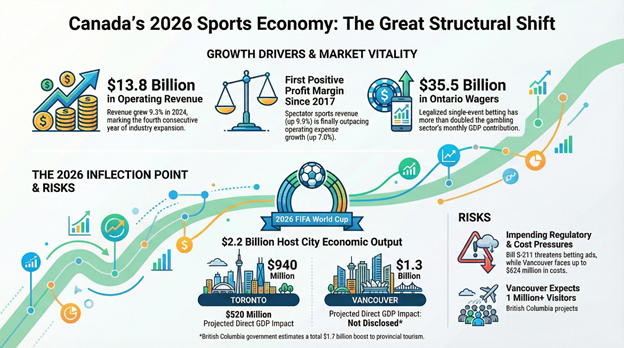
Statistics Canada released data in February 2026 showing that operating revenue in the spectator sports, event promoters, and related industries rose 9.3% from 2023 to reach $13.8 billion in 2024. That was the fourth consecutive year of growth. The spectator sports segment alone — teams playing in front of paying crowds, racing events, independent athletes — hit a record high of $4.8 billion, up 9.9% year-over-year. For the first time since 2017, the spectator sports industry posted a positive profit margin.
That last point is easy to overlook, but it matters. Operating expenses for spectator sports grew 7.0% in 2024, while revenue grew 9.9%. Three years running, revenue growth has outpaced cost growth. That’s not luck. That’s a structural shift.
The sporting goods retail side of the equation tells a slightly different story: more modest growth at a CAGR of 1.3%, reaching an estimated $12.3 billion in 2025. Steady, not spectacular. The real momentum is in live events and digital engagement.
The FIFA Factor: Vancouver and Toronto Are About to Be Tested
The FIFA World Cup comes to North America in the summer of 2026 — 48 teams, 104 matches across the U.S., Canada, and Mexico. Canada’s two host cities are Vancouver and Toronto, and neither has hosted anything quite at this scale.
The projections are significant. Toronto’s six World Cup matches are expected to generate $940 million in economic output for the Greater Toronto Area, including $520 million in direct GDP contribution and the creation or preservation of more than 6,600 jobs, according to FIFA and Deloitte’s official impact studies. Vancouver, set to host seven matches, projects even higher at roughly $1.3 billion in economic output, with British Columbia’s government estimating over 1 million additional out-of-province visitors between 2026 and 2031 and a $1.7 billion boost to provincial tourism.
Those numbers come with genuine caveats. Academic economists have long warned that mega-event impact studies are often commissioned to support the political decision already made, and the history of World Cup host cities includes plenty of examples where projections ran well ahead of reality. Tourism displacement — regular visitors avoiding a city during the chaos — can eat significantly into the gross receipts. Public costs for Vancouver alone are estimated between $532 million and $624 million as of June 2025.
Still, the reputational and long-term tourism effects are harder to dismiss for Canada. The country isn’t trying to put itself on the map; it’s trying to solidify its position in a competitive global tourism and sports entertainment market. If the tournament runs well — and Canada’s venues, particularly BC Place in Vancouver, are widely regarded as World Cup-ready — the lasting brand association with a tournament watched by hundreds of millions of people worldwide carries real commercial value.
What Bill C-218 Set in Motion
The FIFA tournament may be the headline, but the deeper structural change in Canadian sports has its roots in a 2021 piece of federal legislation.
Bill C-218, the Safe and Regulated Sports Betting Act, amended the Criminal Code to allow single-event sports betting across Canada. Before that, bettors could only legally wager on parlays — bundles of multiple outcomes. The change sounds administrative. The financial consequences were not.
Ontario moved first. iGaming Ontario launched in April 2022, opening the province’s online gambling market to private operators. In the first year alone, Ontario’s licensed operators generated $35.5 billion in total wagers, translating into $1.4 billion in revenue. According to Statistics Canada data, Canada’s gambling industries sector has more than doubled in monthly GDP contribution since 2020, reaching the $4.18 to $4.25 billion range through mid-2025. Analysts projected a 10.1% growth in Canada’s total gambling revenue for 2025.
Alberta has been watching Ontario closely and is now moving toward a competitive open-market model of its own via the iGaming Alberta Act. Other provinces continue to operate through government monopolies. The result is a two-tier country, but one where the Ontario experiment has already proven that private-market competition can generate revenue at scale.
The convergence of legalized single-event betting, the expansion of mobile wagering platforms, and the structural shift in how Canadians engage with sports in real time — through in-play betting, stat tracking, and personalized alerts — has changed the relationship between sports fandom and commercial activity. These aren’t casual bets on Friday nights anymore. They’re integrated into the live sports experience itself.
New Platforms, New Revenue Streams
The growth of Canada’s sports industry in 2026 can’t be understood without acknowledging the digital infrastructure that now sits beneath it.
A few trends worth tracking:
- eSports revenue in Canada is forecast to exceed $177 million by 2028, and it’s among the fastest-growing segments in the country’s overall sports event market, which is projected to expand at a CAGR of 9.2% from 2025 to 2030.
- Streaming services are expanding access to leagues and events that previously depended on cable contracts, opening revenue streams for smaller organizations.
- Crypto-based platforms and digital payment integration have opened new engagement channels. The growing interest in blockchain-adjacent gaming and betting formats — including casual gamers drawn in by accessible formats — reflects changing consumer behavior among younger demographics. The broader pattern of players seeking low-barrier entry points in online entertainment is visible in data on crypto gambling adoption in Canada, particularly among users who may not engage with traditional sportsbooks.
- Live attendance is recovering and holding. Admissions to live sporting events were the fastest-growing component of sales in 2024, increasing $162.6 million and accounting for 52.5% of total sales — the first time that figure has crossed the majority threshold since before the pandemic.
The Risks That Come With the Opportunity
A turning point cuts both ways. Canada’s sports industry has real vulnerabilities in 2026 that don’t get enough attention.
Advertising regulation is coming. Since Ontario’s iGaming launch, sports betting ads have flooded Canadian airwaves. Senator Marty Deacon’s Bill S-211 would establish a national framework for gambling advertising, potentially restricting celebrity endorsements and limiting ad placement around programming likely to reach minors. The industry knows it’s coming. The question is how disruptive the transition will be.
Public health concerns are growing. Data from Ontario’s gambling helpline shows a sharp rise in calls related to online gambling since the provincial expansion. Young men are the demographic most likely to engage in sports betting, and public health researchers have flagged the need for better data on how many minors are participating in what is technically a 19-and-over activity.
The World Cup’s economic returns are not guaranteed. Both Toronto and Vancouver are managing significant public cost commitments for an event that will last a few weeks. Converting that short-term stimulus into lasting tourism infrastructure and international recognition requires deliberate post-event planning — something Canadian cities have historically been inconsistent at executing.
What Separates 2026 From Other Years
The spectator sports industry posted a positive profit margin in Canada for the first time since 2017. The country is co-hosting the largest soccer tournament ever staged. Legal single-event betting has rewired how Canadians relate to sports commercially. Alberta is following Ontario’s iGaming lead. And five Canadian NHL teams made the 2025 postseason, with the Toronto Blue Jays returning to the World Series for the first time since 1993 — a run that pushed betting engagement and fan spending to measurable new highs.
None of these forces operates in isolation. Together, they represent the most significant convergence of structural and event-driven factors the Canadian sports industry has seen in a long time. For a useful framework on how these trends are playing out across the broader sports economy, the Statistics Canada annual report on spectator sports and related industries provides a grounded baseline.
Whether 2026 is remembered as a genuine inflection point depends largely on what happens after the final whistle in Vancouver. The conditions are as favorable as they’ve been in decades. Whether Canadian sports organizations, governments, and commercial operators capitalize on them is a separate question entirely.